This content is for educational purposes only and does not constitute legal or investment advice. For your specific situation, consult a licensed immigration attorney and FINRA-registered financial advisor.
EB-5 visa education savings start when a green card from the $800,000 program qualifies an international student for in-state rates worth $200,000 or more over four years. Concurrent filing of I-526E and I-485 delivers work and travel authorization within months, eliminating dependence on the H-1B lottery and the visa interview backlogs that have left some Indian applicants waiting over 500 days for a consulate appointment. Green card holders also access merit scholarships, federal financial aid, and federal student loans at 5 to 7% interest instead of 10 to 11% private international rates. The guide below covers program mechanics, tuition tier structure, scholarship eligibility, internship freedom, and why permanent residency is the structural fix for the constraints international students face from admission through graduation.
Understanding the EB-5 Immigration Program
The EB-5 visa is a powerful alternative to the traditional international student pathway. The program was established by the federal government in 1990 to boost the U.S. economy and provides a direct pathway to a U.S. green card through investment immigration. The EB-5 visa allows individuals already in the United States to concurrently file for their Employment authorization document (work authorization) and their Advanced Parole (Travel Authorization) when they file the initial EB-5 petition. These interim benefits are what are particularly attractive for international students and H-1B professionals.
How EB-5 Works for International Students
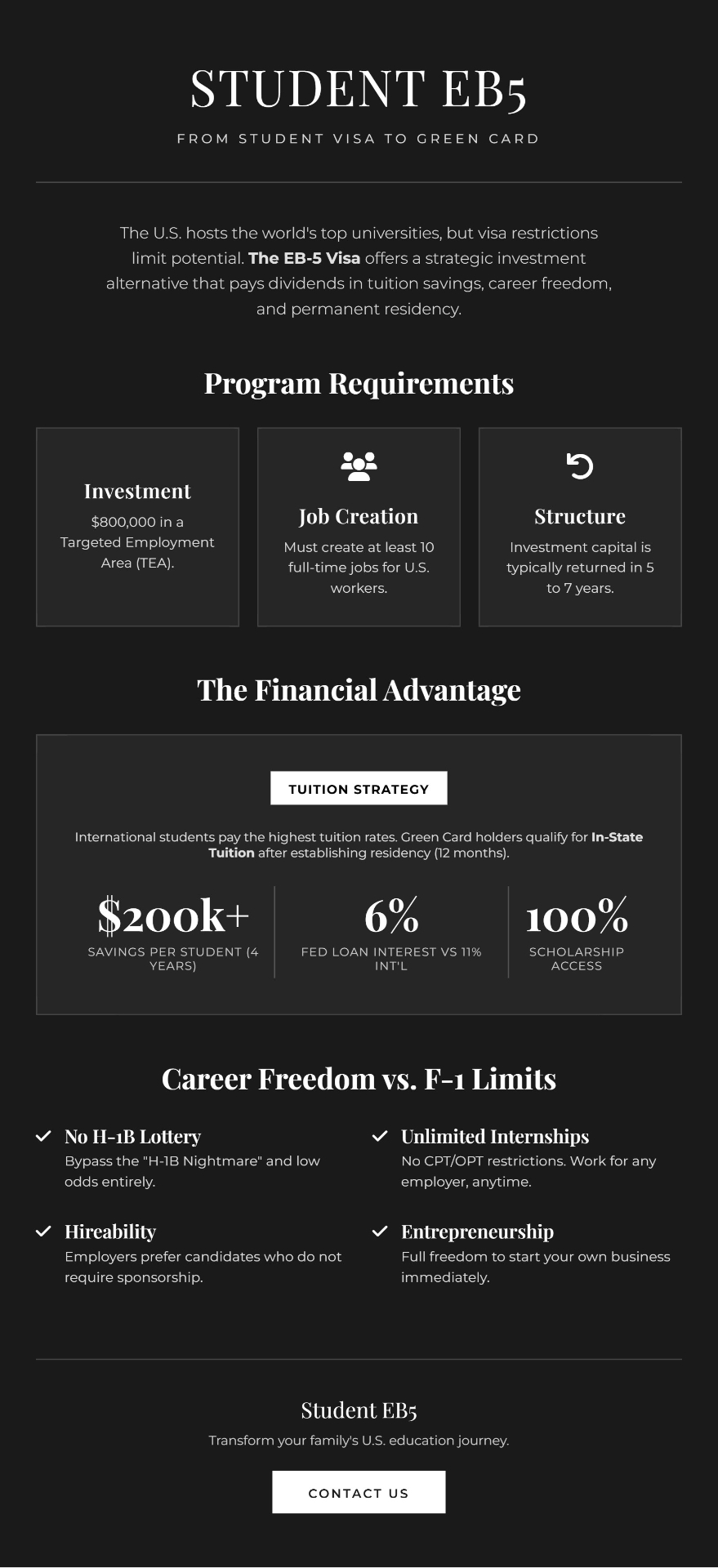
The EB-5 program grants investors, their spouses and unmarried children under the age of 21 permanent residency in the United States. The requirements for the EB-5 program are the following:
• Minimum Investment: $800,000 in a TEA (Targeted Employment Area) or $1,050,000 in a non targeted area
• Job Creation: The EB 5 investment must create at least 10 new permanent full time jobs for qualified U.S. workers
• Source of funds documentation: The investor must document the lawful origin of investment capital
• Investment Structure: Funds are typically invested in real estate or business projects and are usually returned in 5 to 7 years
The key difference: EB-5 immigration is an investment, not a donation or fee. You have the potential to recover your capital while gaining permanent residency for your entire family.
Advantages of EB-5 for Prospective Students
The EB-5 visa brings certainty to what is an unpredictable and high stress journey. An international student with a green card doesn't have to wait for student visa processing, risk consulate closure, travel and re-entry risk, or face the possibility of visa denial after receiving university admission. The green card grants permanent residency and gives the investor the same benefits and opportunities that they would have as if they were a naturalized citizen.
Many students receive admission to their dream university only to face devastating visa denials or months (sometimes year) long delays due to consulate backlogs. Some students immigration applicants in countries like India have waited over 500 days just for a visa interview appointment. The EB-5 visa eliminates the entire source of stress and uncertainty and gives the international student the freedom to explore their potential during their studies.
Financial Advantages: Massive Tuition Savings
Understanding the U.S. tuition structure is crucial to appreciating the financial power of an EB-5 visa green card. The United States has three tiers of tuition:
1. In-State Tuition (Lowest Cost): For students who reside in the state where the university is located for at least 12 months. This is the most affordable type of tuition.
2. Out of state tuition (Middle Cost): For students who are U.S. residents but live outside the state where the university is located. Still significantly cheaper than international rates.
3. International Student tuition (Highest Cost): For students who are not U.S. residents. This is the most expensive way to attend a U.S. university.
With an EB-5 visa Green Card investors can save $200,000+ over four years by qualifying for in-state tuition rates. If you have a Green Card you can move to your desired state and establish residency by attending high school for a year or studying at a community college and then qualify for in-state tuition at top universities like UC Berkley, UCLA or USC.
For a family with multiple children pursing US immigration and U.S. education these savings can total $400,000 to $600,000+ and make a significant portion of your EB 5 investment self-funded through tuition savings alone.
Access to Scholarships and Grants
U.S. permanent residents have significantly better changes of winning scholarships or grants for studying at U.S. universities.
Why Green Card Holders Win More Financial Aid
Most scholarships and grants are restricted to U.S. citizens and permanent residents. International students compete for a much smaller pool of funding. Green card holders may be eligible for:
• Merit based scholarships
• State grant programs
• Private scholarships restricted to residents
• Tuition-free education programs
Federal Student Loans Through Immigration and Investment
U.S. permanent residents have access to federal student loans for education which are substantially cheaper than private international student loans.
The Interest Rate Advantage
Federal student loans usually range from 5-7% interest rates while international student loans range from 10-11% or higher per annum in most countries. These savings can be astronomical over the course of the loan.
Access to federal loans means you can finance your education affordably without the burden of higher interest rates on private loans.
Freedom to Choose Any Educational Course
Not every course or program qualifies under the F1 student visa requirements. When a student is on an F-1 visa they can only attend courses that meet specific visa category criteria. As a green card holder, the student has absolute flexibility to take any course at any institution, switch majors without visa complications, pursue non-traditional educational pathways and take gap years without jeopardizing your status. This freedom allows you to explore your interests and change direction without immigration consequences.
Your Next Step
See the EB-5 Path From Student Visa to Green Card
EB-5 can secure permanent residency without the H-1B lottery or employer sponsorship after graduation.
100% confidential. We never contact your employer.
Broad Internship Opportunities Leading to Job Offers
A green card dramatically expands your internship opportunities which can directly lead to job offers upon graduation. International students often fail to secure internships during their school years because:
• Many employees are hesitant to hire students with uncertain visa status
• Many internships require work authorization that F-1 students don't have
• CPT (Curricular Practical Training) has strict limitations
• Companies prefer candidates who can transition to full-time employment
The EB-5 visa has no work authorization barriers, is more attractive to employers, allows you to start a business and has better networking opportunities than any student visa can offer.
The H-1B Nightmare for International Graduates
Most international students dread facing the stressful reality after graduation of finding a H-1 sponsor. Calculate your OPT expiration date to see how much runway you have before the H-1B lottery becomes your only option. The H-1B lottery has extremely low odds and with new expected policy changes the odds will get even lower. If an applicant is not accepted the international student must leave the United States or scramble for alternatives. A student with a green card does not have to get H-1B sponsorship and has the flexibility to choose their own job, career or start a business if they decide to do so. Learn more about securing US residency after graduation through the EB-5 pathway.
Watch: EB-5 Investment Immigration Explained
Learn more about how the EB-5 immigrant investor program can transform your path to U.S. permanent residency:
Conclusion: Investment Immigration for Students
EB-5 investment immigration is one of the fastest ways to gain U.S. permanent residence. For families with students, it's not just an immigration solution, it's a strategic investment that pays dividends through:
✓ $200,000+ in tuition savings per student over four years
✓ Access to scholarships and grants worth tens of thousands more
✓ Affordable federal student loans instead of high-interest private loans
✓ Unlimited work opportunities during and after school
✓ Superior internship access leading to better job offers
✓ Career freedom without visa restrictions or employer dependency
✓ Family coverage including Green Cards for spouse and children under 21
✓ Investment return potential as your capital may be repaid after 5-7 years
At StudentEB5 we specialize in providing resources for international students and H1B professionals to leverage the EB-5 program to transform their experience in America.
Contact us to learn more about EB-5 investment immigration.
Frequently Asked Questions
What are the benefits of concurrent filing with an EB-5 petition?
Concurrent filing allows the EB-5 investor to stay in the United States legally and receive interim benefits like work authorization (EAD) and travel authorization (AP) while the EB-5 petition is being processed by USCIS. This is extremely valuable for investors who are already in the United States on nonimmigrant visas.
What happens after my EB-5 petition is approved?
After the I-526E petition is approved the investor can adjust their status. After adjustment of status approved the investor will receive conditional permanent residency for two years.
How long will the EB-5 process take?
Processing times vary based on country of origin, current visa availability and USCIS. If the investor concurrently files the I-526E (Initial EB-5 petition), I-485 (Adjustment of Status), Employment Authorization Document and Advance Parole and the regional center has an approved I-956F the processing times can be as short as three to six months for the Work and Travel authorization, six to eight months for the I-526 approval if investing in a rural project which has priority processing and an additional six to eight months for the I-585 approval after the I-526 approval.
What are the main financial benefits of obtaining an EB-5 visa compared to studying on an F-1 visa?
The EB-5 visa grants permanent residency which allows international students to qualify for in-state tuition (which is significantly lower than international student tuition). Additionally, green card holders have access to a broader range of scholarships, grants, federal student loans, and more favorable interest rates than private international loans. For families with multiple children, the combined savings can substantially offset the EB-5 initial investment cost.
How does the EB-5 visa program provide greater academic flexibility for international students?
With an EB-5 green card, international students can freely choose any course or major without the restrictions imposed on F-1 visa holders. They can take gap years or transfer between institutions without risking their immigration status. This flexibility supports a more personalized and exploratory educational experience and is unbound by the strict timelines and limitations of traditional student visa.
In what ways does the EB-5 visa improve career prospects for international students in the U.S.?
EB-5 green card holders enjoy unrestricted work authorization which makes them more attractive to employers for internships and full-time employment. This eliminates the challenges associated with the H-1B visa lottery system commonly faced by F-1 visa students after graduation and ultimately provides a more secure and straightforward path to building a career in the United States.
Disclaimer: The opinions expressed on this website are solely those of the author/presenter. The information provided is for general informational purposes only and should not be considered professional or legal advice. Student EB5 and its contributors do not endorse or take responsibility for any actions taken based on the information presented here. Visitors are strongly advised to consult with qualified immigration attorneys and financial advisors before making any EB-5 investment decisions or taking any actions based on the content on this website.
Share this article
Discuss with AI
Click to copy a formatted prompt, then paste it into your preferred AI assistant.