
This content is for educational purposes only and does not constitute legal or investment advice. For your specific situation, consult a licensed immigration attorney and FINRA-registered financial advisor.
EB-5 for Indian Students and Chinese Students on F-1 and STEM OPT can provide an alternative path to a U.S. green card. Optional Practical Training has long given graduates a structured path to work in the United States. STEM OPT can add 24 months after the initial 12 month OPT period, for up to three years of post-completion work authorization. That pathway has become less predictable and less certain in 2026 than in prior years. The current administration has been critical of F-1 and OPT, and with ongoing tech layoffs and weak H-1B selection rates, more STEM OPT international students from India and China now treat EB-5 as the primary route to permanent residency.
STEM OPT Structure, I-765 Timing, and Extension Risk
STEM OPT is practical training tied to an F-1 student's qualifying STEM degree. To seek the extension, the graduate must hold a degree on the DHS STEM Designated Degree Program List and must apply while still in a valid period of post-completion OPT.

Photo by Brelyn Bashrum on Unsplash
Timing is rigid. Form I-765 for STEM OPT may be filed up to 90 days before initial OPT ends. Filing late can leave a gap with no work authorization. Use an OPT calculator to map program end date, earliest and latest filing dates, and remaining runway. If the student files on time, work authorization can continue for up to 180 days while USCIS adjudicates the STEM OPT request.
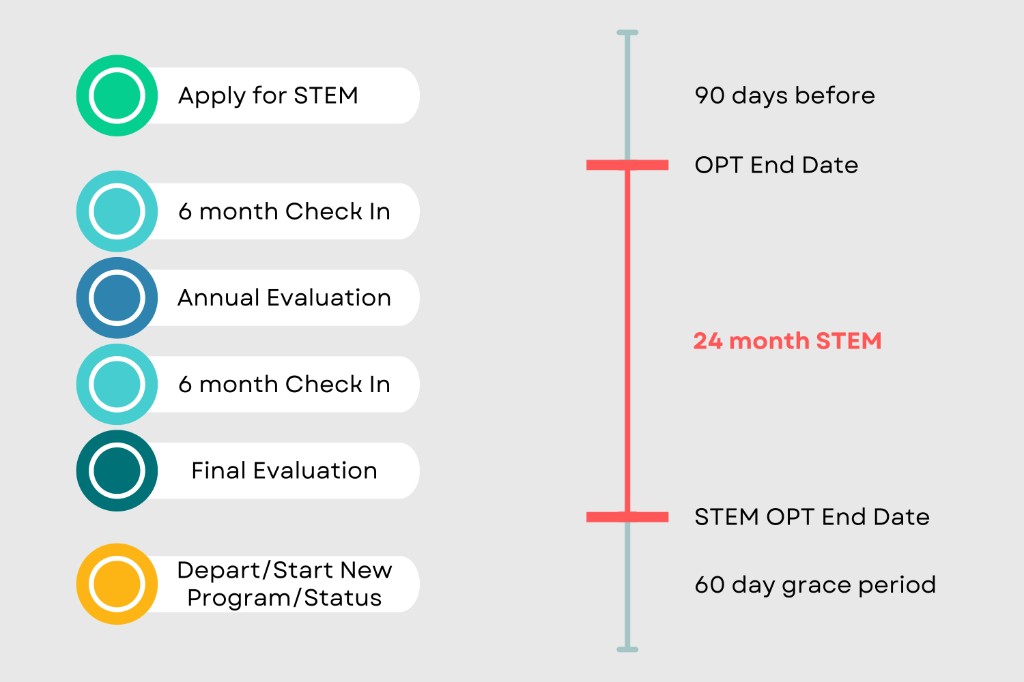
For Indian and Chinese STEM graduates, the extension is temporary relief, not a green card path. STEM OPT still depends on an eligible employer, reporting rules, and a hard end date. When the extension expires, the next step is usually the H-1B lottery or another nonimmigrant category. That is where cap-gap and lottery risk concentrate.
2026 Regulatory Threats: Duration of Status and OPT Re-Evaluation
F-1 status and OPT face active regulatory pressure in 2026. DHS published a notice of proposed rulemaking to end "Duration of Status" (D/S) for F-1 students. Under D/S, many students stay for the length of their program without a fixed I-94 end date. The proposed rule (submitted for final review as of May 2026) would replace D/S with a fixed admission period, commonly discussed as a four-year cap. Students in longer programs, or those moving into OPT, would need formal extension-of-stay filings with USCIS, including biometrics and adjudication. The proposal would also shorten the post-completion grace period from 60 days to 30 days and tighten how graduate students may change programs or majors, though final text has not been published.
DHS has also stated it is reviewing the scope and length of OPT and STEM OPT, citing worker displacement, fraud, and national security. Final text is not settled, but the direction is clear: less automatic continuity and more filing friction for F-1 and STEM OPT holders. For Indian and Chinese students who planned on a predictable STEM OPT runway into H-1B, that policy shift is a direct planning risk, not a distant headline.
The H-1B Lottery and the Cap-Gap Dilemma
The H-1B category is limited to 85,000 visas per fiscal year, which drives a competitive lottery. Use the H-1B Lottery Odds Calculator to see how selection pressure looks in practice. Students who are not selected still face OPT or STEM OPT expiration.
Cap-gap is the timing gap between OPT end dates and the October 1 H-1B start date. Cap-gap protection applies only when an H-1B petition is selected and pending under the regulations. Students who lose the lottery do not get that bridge. They must depart, change to another nonimmigrant status, or enroll in a new academic program before OPT or STEM OPT expires. When STEM OPT ends without a selected H-1B, the window to leave, enroll in a new program, or move to another status is short.
H-1B status is also employer-tied. After a termination, workers generally have a 60-day grace period to find new sponsorship or change status. For STEM OPT students already watching D/S and OPT rule risk, adding H-1B lottery odds and layoff exposure stacks three separate failure points on one career plan.
Your Next Step
On OPT and Running Out of Time?
EB-5 concurrent filing can bridge the gap between OPT expiration and a self-sponsored green card path.
Or request a free 30-minute evaluation below.
100% confidential. We never contact your employer.
EB-5 as a Self-Sponsored Alternative
Faced with lottery odds and F-1 regulatory risk, many Indian and Chinese STEM OPT students evaluate EB-5 as a self-sponsored path to permanent residency. The program requires a qualifying investment of $800,000 in a Targeted Employment Area or $1,050,000 outside a TEA, and the investment must create 10 full-time jobs for U.S. workers. The capital bar is high, but the STEM and early-career professional profile often aligns with family-funded or structured capital sources when documentation is prepared correctly.
For the full F-1 filing roadmap, intent timing, and process detail, use the F-1 to EB-5 green card guide. This article focuses on why STEM OPT timing and 2026 regulatory risk push that decision earlier.
Concurrent Filing in Brief
The EB-5 Reform and Integrity Act of 2022 allows eligible investors already in lawful U.S. status to file Form I-526E together with Form I-485. Concurrent filing supports requests for an Employment Authorization Document and Advance Parole. After EAD approval, the investor can work without OPT employer limits or H-1B sponsorship, which changes the risk profile for STEM OPT students racing a fixed end date.

For process detail across F-1, J-1, and H-1B, see EB-5 concurrent filing for J-1, F-1, and H-1B.
Grandfathering Deadline: September 30, 2026
RIA grandfathering protects I-526E petitions filed on or before September 30, 2026. Those filings remain adjudicable even if the regional center program is not reauthorized on the later schedule. STEM OPT students who wait for one more lottery cycle can lose both work authorization runway and that filing protection at once.
For deadline mechanics and the 2027 distinction, see EB-5 grandfathering deadlines. Use our EB-5 Feasibility Calculator to check whether your current assets qualify before the September 30, 2026 grandfathering deadline, then schedule a free consultation to review your STEM OPT timeline against the filing window.
---